
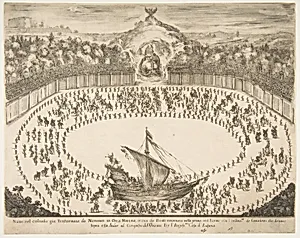
Parade float in the form of a ship, coat of arms of the Grand Duke of Modena at top
Medium
Etching, engraving
Dimensions
Sheet: 9 5/16 × 11 5/8 in. (23.6 × 29.6 cm)
Classification
Prints
Department
Drawings and Prints
Museum
Metropolitan Museum of Art, New York, NY
Credit
The Elisha Whittelsey Collection, The Elisha Whittelsey Fund, 1967
Accession Number
67.542.2
Rights
Public Domain
Tags
Art Historical Context
Behold this intricate etching by Stefano della Bella, a masterful 17th-century Italian printmaker renowned for his lively depictions of festivals and spectacles. Titled *Parade float in the form of a ship, coat of arms of the Grand Duke of Modena at top*, this 1652 work captures a grand Baroque procession float shaped like a majestic ship, proudly bearing the heraldic emblem of Modena's ruler, likely Francesco I d'Este. The scene buzzes with energy: horses pull the elaborate structure through an enthralled crowd, evoking the opulent public celebrations of Italy's ducal courts. Created during the height of Baroque extravagance, the print reflects how Renaissance nobility used such floats—part theater, part propaganda—to dazzle subjects and affirm power. Della Bella, who trained in Florence and worked across Europe, excelled at these festive vignettes, blending detailed observation with dramatic flair. Modena's Este family, patrons of the arts, hosted lavish carnivals where nautical themes symbolized naval might amid Italy's fragmented city-states. The medium of etching and engraving shines here, allowing Della Bella's fine lines to convey motion, texture, and scale on a modest 9 5/16 × 11 5/8 in. sheet. Now in the Metropolitan Museum of Art's Drawings and Prints department (The Elisha Whittelsey Collection, 1967), it invites us to relive 17th-century splendor.
About the Artist
Stefano della Bella · 1610–1664
Stefano della Bella (1610-1664) was one of the most prolific and versatile printmakers of the Italian Baroque period, leaving behind 1,052 prints and several thousand drawings that captured the vivid essence of 17th-century European life. Born in Florence on May 18, 1610, to a family of artists, he trained initially as a goldsmith before studying painting under Cesare Dandini and etching under Rem...