
Paradise
Medium
Tempera and gold on canvas, transferred from wood
Dimensions
18 7/16 × 16 1/16 in. (46.8 × 40.8 cm); painted surface 17 1/2 x 15 1/8 in. (44.5 x 38.4 cm)
Classification
Paintings
Department
European Paintings
Museum
Metropolitan Museum of Art, New York, NY
Credit
Rogers Fund, 1906
Accession Number
06.1046
Rights
Public Domain
Tags
Art Historical Context
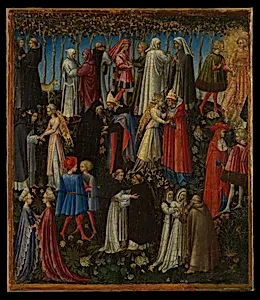
Giovanni di Paolo di Grazia, a leading Sienese painter of the 15th century, created *Paradise* in 1445 using tempera and gold on—originally painted on wood panel, a common medium for religious art of the International Gothic style. This intimate work (18 7/16 × 16 1/16 in.) vividly captures a heavenly garden teeming with saints, angels men, and women, alongside playful details like rabbits frolicking amid lush greenery. The lavish gold ground evokes divine radiance, transporting viewers to an idealized Eden. Di Paolo's style blends late Gothic elegance with early Renaissance naturalism, characteristic of Siena's artistic tradition, where decorative richness and fantastical elements reigned. Tempera, mixed with egg yolk, allowed for jewel-like colors and fine details, while gold leaf heightened the spiritual luminescence typical of predella panels or altarpiece scenes. Acquired by the Metropolitan Museum of Art in 1906 via the Rogers Fund, it exemplifies how such paintings served as devotional focal points in churches, inspiring contemplation of eternal bliss. Today, *Paradise* delights with its whimsical menagerie—rabbits symbolizing paradise's harmony—and intricate figures, offering a window into medieval Christian visions of the afterlife. A gem of European Paintings, it invites you to linger on its luminous allure.