
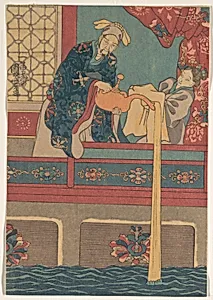
Paragons of Filial Piety (from a set of twenty-four)
mid-19th century
Medium
Woodblock print; ink and color on paper
Dimensions
H. 5 7/8 in. (14.9 cm); W. 4 1/8 in. (10.5 cm)
Classification
Prints
Culture & Period
Japan · Edo period (1615–1868)
Department
Asian Art
Museum
Metropolitan Museum of Art, New York, NY
Credit
Gift of Lincoln Kirstein, 1966
Accession Number
JP3518a–j
Rights
Public Domain
Tags
Art Historical Context
In the vibrant world of 19th-century Japan, Utagawa Kuniyoshi crafted *Paragons of Filial Piety (from a set twenty-four)*, a woodblock print from the period (1615–8). This intimate piece, measuring just 5 7/8 x 4 1/8 inches, exemplifies ukiyo-e—the "pictures of the floating world"—a popular art form that brought storytelling to the masses through affordable, mass-produced prints. Kuniy, renowned for his dynamic warrior scenes and whimsical animal depictions, turned his mastery to moral tales here, rendering vivid scenes with men, women, children, animals, and even elephants in ink and color on paper. The series draws from Confucian ideals of filial piety, celebrating 24 legendary stories of children’s extraordinary devotion to their parents. These narratives, rooted in Chinese lore but beloved in Japan, reinforced social harmony during the Edo era’s stable yet hierarchical society. Kuniyoshi’s composition likely captures one such dramatic episode, blending human figures with exotic animals to heighten emotional impact and visual intrigue. Woodblock printing’s layered technique—carving intricate blocks for each color—allowed Kuniyoshi to achieve bold contrasts and subtle gradients, making this small print a portable window into virtue and folklore. Donated to the Metropolitan Museum of Art in 1966, it invites us to reflect on timeless family bonds across cultures.
About the Artist
Utagawa Kuniyoshi · 1797–1861
Utagawa Kuniyoshi (1797–1861) was born in Edo to the silk-dyer Yanagiya Kichiyemon, originally bearing the childhood name Yoshisaburō. From a young age, he assisted in his family's pattern design work, which sharpened his innate mastery of color and textile motifs that would permeate his later prints. At around twelve years old, his prodigious drawing skills drew the attention of the renowned Utag...