
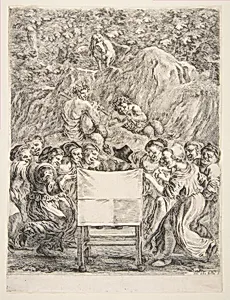
Parnassus, frontispiece to Les Oeuvres de Scarron
Medium
Etching, state ii
Classification
Prints
Department
Drawings and Prints
Museum
Metropolitan Museum of Art, New York, NY
Credit
The Elisha Whittelsey Collection, The Elisha Whittelsey Fund, 1949 by exchange
Accession Number
68.745
Rights
Public Domain
Tags
Art Historical Context
Welcome to the Metropolitan Museum of Art's Drawings and Prints collection, where Stefano della Bella's *Parnassus*, etched in collaboration with Toussaintinet in 1649, serves as the elegant frontispiece for Paul Scarron's *Lesuvres de Scarron*. Baroque-era print captures the mythical Mount Parnassus, sacred home of the Muses surrounded by lively figures of men, women, and animals in a celebration of poetry and inspiration. Scarron, a witty French burlesque writer known for his humorous verse, commissioned this image to adorn his collected works, blending classical mythology with 17th-century exuberance. Della Bella, a masterful Italian etcher renowned for his intricate, dynamic compositions, designed the scene, while Quinet executed the etching—a technique prized for its fluid lines and rich tonal depth. This second state (state ii) reflects refinements to the plate, showcasing the artists' precision in rendering swirling clouds, flowing drapery, and teeming life. Etchings like this were revolutionary for book illustration, making high art accessible through reproducible prints. Culturally, *Parnassus* embodies the era's reverence for literary genius amid France's vibrant intellectual scene under Louis XIV's early reign. A delightful nod to creativity, it invites us to climb our own Parnassus—perhaps with Scarron's playful verses in hand! (Credit: The Elisha Whittelsey Collection, 1949.)
About the Artist
Stefano della Bella|Toussaint Quinet · 1610–1664
Stefano della Bella (1610-1664) was one of the most prolific and versatile printmakers of the Italian Baroque period, leaving behind 1,052 prints and several thousand drawings that captured the vivid essence of 17th-century European life. Born in Florence on May 18, 1610, to a family of artists, he trained initially as a goldsmith before studying painting under Cesare Dandini and etching under Rem...