
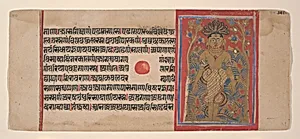
Parsvanatha's Austerities: Folio from a Kalpasutra Manuscript
Unknown Artist
15th century
Medium
Ink, opaque watercolor, and gold on paper
Dimensions
Overall: 4 3/8 x 10 1/8 in. (11.1 x 25.7 cm)
Classification
Paintings
Culture
India (Gujarat)
Department
Asian Art
Museum
Metropolitan Museum of Art, New York, NY
Credit
Anonymous Gift, 1957
Accession Number
57.185.4
Rights
Public Domain
Art Historical Context
This exquisite folio from a 15th-century Kalutra manuscript, hailing Gujarat, India, captures the austerities Parsvanatha, the23rd Tirthank in Jainism. The Kalpasutra, a sacred Jain text, recounts the lives of revered spiritual teachers, and such illuminated pages were pivotal during festivals like Paryushan, where manuscripts were ritually displayed and recited. Created in the Western Indian miniature painting tradition, this artwork reflects the devotional artistry of anonymous Jain scribes and painters, blending spirituality with intricate visual storytelling. Rendered in ink, opaque watercolor, and gold on paper, the folio exemplifies the luminous techniques of Gujarati Jain manuscripts. Fine ink outlines define figures and architecture, while vibrant opaque watercolors—often layered for depth—bring scenes of ascetic endurance to life. Gold accents, applied with precision, illuminate divine elements, symbolizing enlightenment and adding a sacred glow that would have shimmered under temple lights. Measuring just 4 3/8 x 10 1/8 inches, this fragile treasure at the Metropolitan Museum of Art offers a window into medieval Jain culture, where art served piety and preserved cosmology. Its survival underscores the enduring reverence for Parsvanatha's path of renunciation, inspiring visitors to ponder the power of disciplined devotion.