
Part of a Kiosk
A.D. 1914–1915; original ca. 1971–1928 B.C.
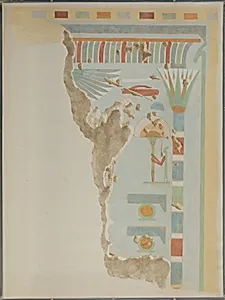
Medium
Tempera on paper
Dimensions
facsimile: h. 59 cm (23 1/4 in); w. 43 cm (16 15/16 in), scale 1:2, framed: h. 62.9 cm (24 3/4 in); w. 47.6 cm (18 3/4 in)
Classification
Facsimile, Senet (TT 60), Intefiqer
Period
Twentieth Century; original Middle Kingdom
Department
Egyptian Art
Museum
Metropolitan Museum of Art, New York, NY
Credit
Rogers Fund, 1930
Accession Number
30.4.161
Rights
Public Domain
Art Historical Context
Behold this exquisite facsimile of *Part of a Kiosk a faithful 1:2 scale reproduction by Hugh R. Hop between A.D. 1914 and 1915. It captures a fragment of an ancient Egyptian architectural element from the Middle Kingdom's Dynasty 12, dating originally to around 1971–1928 B.C. During this golden era of pharaonic stability and cultural revival, kiosks served as ornate open pavilions in temples, often dedicated to deities or royal ceremonies, adorned with intricate reliefs symbolizing divine order and kingship. Hopgood's rendition, executed in tempera on paper—a medium prized for its vibrant, durable pigments and fine detail—brings the hieroglyphic precision and symbolic motifs of Middle Kingdom artistry to life. Acquired through the Rogers Fund in 1930, this Twentieth-Century treasure in the Metropolitan Museum of Art's Egyptian Art department allows modern visitors to marvel at the Egyptians' masterful stone-carving techniques, now preserved in vivid color for study and appreciation. Step closer to glimpse the enduring legacy of ancient innovation, where every line echoes a civilization's devotion to eternity.