
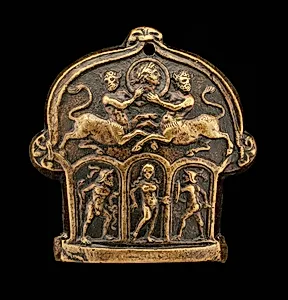
Part of a Sword Pommel (Centaur Supporting Medallion; Venus Flanked by Mars and Hercules)
1401 to 1500
Medium
bronze//Light brown patina
Dimensions
overall: 3.78 x 3.65 cm (1 1/2 x 1 7/16 in.) gross weight: 33.52 gr (0.074 lb.)
Classification
Sculpture
Department
CSD
Museum
National Gallery of Art, Washington, D.C.
Credit
Samuel H. Kress Collection
Accession Number
1957.14.227
Rights
Public Domain
Art Historical Context
This exquisite bronze sword pommel, by the renowned Italian goldsmith and medallist Caradossooppa between 1401 and 150, exemplifies the Renaissance with classical mythology and virtuoso metalwork. Measuring just 3.78 x 3.65 cm and weighing a mere 33.52 grams, it once adorned the hilt of a nobleman's sword, blending martial function with artistic splendor. Caradosso, active in Milan and later Rome under papal patronage, was celebrated for his intricate medals and small sculptures that revived ancient motifs with humanist elegance. The pommel's design features a dynamic centaur supporting a medallion depicting Venus flanked by Mars and Hercules—gods of love, war, and heroic strength. This mythological tableau reflects Renaissance Italy's revival of Greco-Roman themes, symbolizing the harmony of beauty, conflict, and valor amid the era's courts and condottieri culture. The light brown patina, a natural oxidation over centuries, enhances its tactile allure and authenticity. Housed in the National Gallery of Art as part of the Samuel H. Kress Collection, this tiny sculpture showcases advanced lost-wax casting techniques, allowing Caradosso to achieve remarkable detail in such a compact form. A testament to the period's technical mastery, it invites visitors to ponder the artistry hidden in everyday objects of power.