
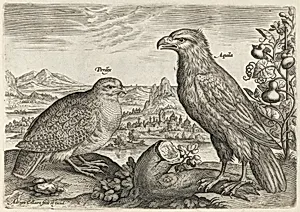
Partridge and Eagle
c. 1600
Medium
engraving on laid paper
Dimensions
plate: 13.2 x 18.8 cm (5 3/16 x 7 3/8 in.)
Classification
Department
CG-E
Museum
National Gallery of Art, Washington, D.C.
Credit
Gift of The Circle of the National Gallery of Art
Accession Number
1993.32.1.r
Rights
Public Domain
Art Historical Context
Adriaen Collaert's *Partridge and Eagle*, created around 1600, exemplifies the exquisite finesse of Flemish engraving during the late Renaissance. Collaert, a master printmaker from Antwerp, was renowned for his intricate depictions of animals and nature, often drawing from direct observation to capture feathers, textures, and lifelike poses. This small-scale work (plate: 13.2 x 18.8 cm) on laid paper—a period-appropriate support with visible chain lines—showcases his skill in translating three-dimensional forms into precise lines on a copper plate, allowing for multiple impressions that made art accessible to collectors across Europe. Engravings like this one were pivotal in the booming print market of the Northern Netherlands, serving both as aesthetic delights and tools for natural history studies amid growing interest in the natural world. The juxtaposition of the majestic eagle and humble partridge may evoke themes of hierarchy in nature or simply celebrate avian diversity, reflecting the era's blend of scientific curiosity and artistic virtuosity. Housed in the National Gallery of Art thanks to the Circle's generous gift, it invites visitors to marvel at how Collaert's burin brought the wild to life on paper.