
Pastoral Cruelty
Medium
Etching on ivory laid paper
Dimensions
Plate: 29 × 19.1 cm (11 7/16 × 7 9/16 in.); Sheet: 38.6 × 24.1 cm (15 1/4 × 9 1/2 in.)
Classification
engraving
Department
Prints and Drawings
Museum
Art Institute of Chicago
Accession Number
133280
Rights
Public Domain
About this artwork
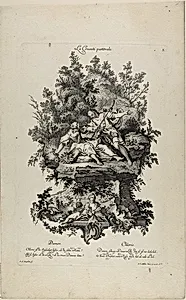
Damon: Chloris! Is solitude better than a secure home? Is it better than the love that true Damon offers you? Chloris: Damon, hold your tongue about your love, which is laughable to me. My freedom and my roses, I love both more than you. Johann Lorenz Rugendas I’s etchings often feature playful vignettes atop classically ornamented stands. Here Damon and Chloris appear in an Arcadian setting, surrounded by lush vegetation. In response to Damon’s declaration of love, Chloris recoils, upendi...
Art Historical Context
"Pastoral Cruelty" a striking etching by Johann Lorenz Rug I, a master engraver from the distinguished Rugendas family of Augsburg, Germany. Created on luxurious ivory laid paper, the measures 29 × .1 cm (11 7/16 × 7 9/16 in.), with the full sheet extending to 38.6 × 24.1 cm (15 1/4 × 9 1/2 in.). Housed in the Art Institute Chicago's Prints and Drawings and classified as an engraving, undated work exemplifies the technical precision of 18th-century printmaking. Rugendas I specialized in intricate etchings that captured dynamic scenes, often blending detailed line work with subtle tonal gradations achieved through acid-bitten plates. Etching on laid paper, with its visible chain lines and watermark-friendly texture, was a favored medium for high-quality reproductions, allowing artists like Rugendas to distribute vivid imagery widely during the Rococo era. This technique brought pastoral motifs—idyllic countryside vistas—into intimate, collectible formats for Europe's burgeoning art lovers. The evocative title "Pastoral Cruelty" suggests a poignant contrast between serene rural harmony and underlying violence, a theme resonant in period genre prints that probed human-nature tensions. As a testament to printmaking's democratic power, it invites us to reflect on beauty's darker shadows, making it a gem for visitors exploring the evolution of graphic arts.