
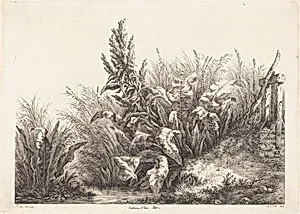
Patience d'eau, étude (Study of a Patience-Dock)
1840
Medium
etching, engraving, and roulette on chine collé
Dimensions
plate: 20.2 x 28.5 cm (7 15/16 x 11 1/4 in.) sheet: 22.2 x 30.5 cm (8 3/4 x 12 in.)
Classification
Department
CG-E
Museum
National Gallery of Art, Washington, D.C.
Credit
Gift of Ruth Fine and Larry Day in memory of George Parides
Accession Number
1997.54.1
Rights
Public Domain
Art Historical Context
Eugène Bléry *Patience d'eau, (Study of a Patienceock)*, created in 1840, the delicate intricacies of the patience-dock plant—a leafy aquatic herb prized for its medicinal uses in 19th-century Europe. As a skilled French printmaker associated with the Romantic landscape tradition, Bléry excelled in rendering nature's subtle textures, bridging artistic observation with scientific precision. This study reflects the era's growing fascination with botany, where detailed plant depictions served both aesthetic delight and scholarly documentation. Crafted through etching, engraving, and roulette on chine collé—a technique adhering thin Chinese paper to a sturdy support for finer detail and richer tones—the print showcases Bléry's mastery of intaglio methods. Etching allows fluid lines, engraving adds sharp precision, and roulette introduces velvety textures mimicking foliage. Measuring just 20.2 x 28.5 cm on the plate, its modest scale invites close viewing, revealing the labor-intensive process typical of mid-19th-century printmaking. Housed in the National Gallery of Art thanks to a generous gift from Ruth Fine and Larry Day, this work highlights Bléry's contribution to the golden age of French reproductive prints, blending artistry with natural history for enduring appeal. Visitors will appreciate its quiet elegance, a testament to nature's quiet beauty.
About the Artist
Eugène Bléry · 1805–1887
Eugène Bléry (1805–1887) was a French engraver and etcher whose refined printmaking brought him considerable recognition among connoisseurs of the graphic arts during the nineteenth century. He trained in Paris and developed a particular affinity for landscape subjects rendered through the demanding medium of etching, where his technical precision and sensitivity to natural light set his work apar...