
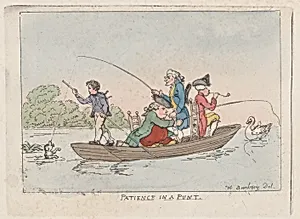
Patience in a Punt
Medium
Hand-colored etching
Dimensions
Plate: 4 3/4 × 6 1/2 in. (12 × 16.5 cm) Sheet: 6 7/16 × 8 1/16 in. (16.4 × 20.5 cm)
Classification
Prints
Department
Drawings and Prints
Museum
Metropolitan Museum of Art, New York, NY
Credit
The Elisha Whittelsey Collection, The Elisha Whittelsey Fund, 1959
Accession Number
59.533.875
Rights
Public Domain
Tags
Art Historical Context
"Patience in a Punt," created around 1803 by Henry William Bunbury with etching by Thomas Rowlandson, the whimsical spirit of British satire through a hand-colored etching. Bunbury, an amateur caricaturist and aristocrat, designed lively scenes of everyday folly, while Rowlandson, a leading figure in Regency-era caricature, brought them to life with his masterful etching technique. This small print (plate 4¾ × 6½ in.) was hand-colored post-printing, a popular method that added vibrant hues and made affordable satirical art accessible to a wide audience, from drawing rooms to taverns. The title playfully nods to the stereotypical angler’s virtue—or trial—of patience, depicting men in a punt, a traditional flat-bottomed boat used on rivers for fishing. Through exaggerated expressions and poses, it satirizes leisurely male pursuits, poking fun at the idleness and anticipation of the sport amid serene waters. Such prints thrived in early 19th-century Britain, reflecting a growing market for humorous commentary on social norms during the Napoleonic era. Housed in the Metropolitan Museum of Art's Drawings and Prints department, this work exemplifies the golden age of British caricature, blending sharp wit with technical finesse. It invites visitors to chuckle at timeless human quirks, reminding us how art has long mirrored life's patient absurdities.