
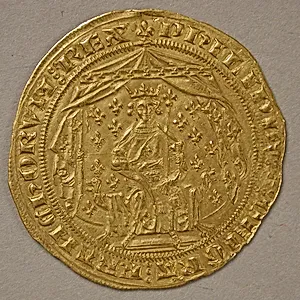
Pavillion D'or of Philip VI
Unknown Artist
1339
Medium
Gold
Dimensions
Overall: 1 3/16 x 1/16 in. (3.1 x 0.1 cm)
Classification
Coins
Culture
French
Department
Medieval Art
Museum
Metropolitan Museum of Art, New York, NY
Credit
Bequest of Joseph H. Durkee, 1898
Accession Number
99.35.109
Rights
Public Domain
Art Historical Context
Step into the glittering world of medieval French royalty with the *Pavillion D'or of Philip VI*, delicate gold coin struck in 1339. Measuring just 1 3/16 x 1/16 inches (3.1 x 0.1 cm), this tiny treasure exemplifies the precision of 14th-century minting techniques. Crafted from pure gold, it served not only as currency but as symbol of royal authority, bearing the name "Pavillion D" – likely referencing a pavilion motif that evoked the grandeur of courtly tents and chivalric display. Philip VI, the first king of the House of Valois (r. 1328–1350), issued this coin amid turbulent times, including the early stirrings of the Hundred Years' War with England. Gold coins like this one were rare and prestigious, reserved for high-value transactions and diplomacy, underscoring France's economic power and artistic sophistication in the Medieval period. Housed in the Metropolitan Museum of Art's Medieval Art department through the 1898 bequest of Joseph H. Durkee, the *Pavillion D'or* invites us to ponder the blend of artistry and utility in everyday royal life. Its survival offers a tangible link to a bygone era, where even money was a canvas for cultural prestige.