
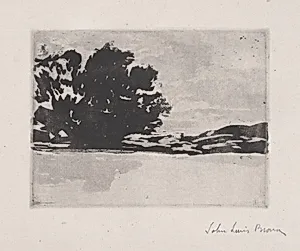
Paysage
19th century
Medium
Aquatint
Dimensions
Image: 4 5/8 × 6 1/4 in. (11.8 × 15.8 cm) Plate: 4 3/4 × 6 5/16 in. (12 × 16 cm) Sheet: 11 1/4 × 13 1/2 in. (28.5 × 34.3 cm)
Classification
Prints
Department
Drawings and Prints
Museum
Metropolitan Museum of Art, New York, NY
Credit
Gift of Durand-Ruel, 1924
Accession Number
24.24.11
Rights
Public Domain
Art Historical Context
John Lewis Brown’s *Paysage*, a delicate 19th-century aquint print, captures the of landscape artistry through its subtle tonal gradations. Created during an era when printmaking flourished as an accessible medium for sharing artistic visions, this small-scale work (image measuring just 4 5/8 × 6 1/4 inches) exemplifies Brown’s skill in evoking natural scenes. The Anglo-French artist, known his dynamic depictions of horses, hunts, and Orientalist subjects, here turns to the serene beauty of *paysage*—the French term for landscape—showcasing his versatility beyond painting. Aquatint, Brown’s chosen technique, revolutionized printmaking by allowing rich, watercolor-like washes of tone through a resin-etched plate. This method, perfected in the late 18th century, was ideal for atmospheric landscapes, enabling effects from deep shadows to luminous skies that mimic oil or gouache. Housed in the Metropolitan Museum of Art’s Department of Drawings and Prints, *Paysage* entered the collection in 1924 as a gift from Galerie Durand-Ruel, the legendary dealer who championed Impressionists like Monet and Renoir—adding a layer of historical prestige to this understated gem. Visitors will appreciate how such intimate prints bridged elite art with broader audiences, preserving Brown’s evocative vision of nature amid the Industrial Age’s transformations. A testament to 19th-century innovation, it invites quiet contemplation of the enduring allure of the outdoors.