
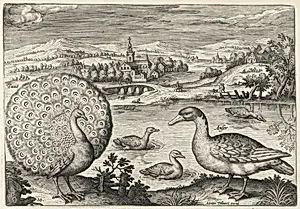
Peacock and Goose
c. 1600
Medium
engraving on laid paper
Dimensions
plate: 13 x 18.8 cm (5 1/8 x 7 3/8 in.)
Classification
Department
CG-E
Museum
National Gallery of Art, Washington, D.C.
Credit
Gift of The Circle of the National Gallery of Art
Accession Number
1993.32.1.k
Rights
Public Domain
Art Historical Context
Adriaen Collaert's *Peacock and Goose*, created around 1600, is a delicate engraving on laid paper, measuring just 13 x 18.8 cm. As a leading Flemish engraver of the late Renaissance, Collaert (c. 1560–1618) was renowned for his intricate depictions of animals, often drawing from nature studies and designs by contemporaries like Johannes Stradanus. This print his skill in the Antwerp engraving tradition, where precision and fine lines captured the textures of feathers and the majesty of birds, making art accessible beyond paintings. Engraving, a labor-intensive intaglio technique, involved incising designs into copper plates with burins, inking the grooves, and printing onto laid paper—distinguished by its visible chain lines from the manufacturing process. At the turn of the 17th century, such prints fueled a growing European fascination with natural history amid explorations and emblematic symbolism; the peacock, with its iridescent tail, evoked pride and beauty, while the goose added a humble, everyday contrast. Collaert's work bridged Mannerist elegance and emerging Baroque realism. Housed in the National Gallery of Art thanks to The Circle's generous gift, this piece invites visitors to marvel at how a small print preserves vivid life, reflecting the era's blend of artistry and scientific curiosity.