
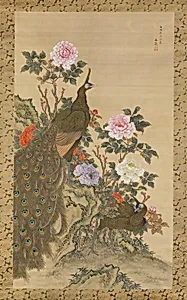
牡丹に孔雀図|Peacocks and Peonies
1820
Medium
Hanging scroll; ink and color on silk
Dimensions
Image: 60 1/4 × 34 3/4 in. (153 × 88.2 cm) Overall with mounting: 79 15/16 × 41 3/4 in. (203 × 106 cm) Overall with knobs: 79 15/16 × 46 3/4 in. (203 × 118.8 cm)
Classification
Paintings
Culture & Period
Japan · Edo period (1615–1868)
Department
Asian Art
Museum
Metropolitan Museum of Art, New York, NY
Credit
Charles Stewart Smith Collection, Gift of Mrs. Charles Stewart Smith, Charles Stewart Smith Jr., and Howard Caswell Smith, in memory of Charles Stewart Smith, 1914
Accession Number
14.76.51
Rights
Public Domain
Tags
Art Historical Context
Tani Bunchō's *Peacocks and Peonies* (1820) is a stunning hanging scroll painted in ink and color on silk, capturing the opulent beauty of nature during Japan's Edo period (1615–1868). Measuring over six feet tall when fully mounted, this work exemplifies the traditional Japanese format of hanging scrolls, designed to be unrolled and displayed on special occasions, transforming a room into a poetic garden. Bunchō, a master of the nanga (Southern school) style influenced by Chinese literati painting, skillfully blends delicate ink washes with vivid pigments to depict majestic peacocks amid blooming peonies, their feathers shimmering in blues, golds, and greens. In Edo-era Japan, peonies symbolized wealth, honor, and feminine beauty—the "king of flowers"—while peacocks evoked immortality, protection, and regal splendor, drawing from shared Sino-Japanese aesthetics. Bunchō's technique highlights meticulous detailing in the birds' iridescent plumage and the lush, layered petals, showcasing his innovative fusion of ukiyo-e vibrancy with scholarly restraint. This piece, from the Metropolitan Museum of Art's Asian Art collection, reflects the period's flourishing urban culture and appreciation for nature's grandeur. A gift to the museum in 1914 from the Charles Stewart Smith family, it invites visitors to ponder the timeless allure of these motifs, bridging centuries of artistic tradition.