
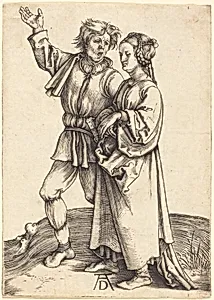
Peasant and His Wife
c. 1497/1498
Medium
engraving on laid paper
Dimensions
sheet (trimmed to plate): 10.8 × 7.7 cm (4 1/4 × 3 1/16 in.)
Classification
Department
CG-E
Museum
National Gallery of Art, Washington, D.C.
Credit
Rosenwald Collection
Accession Number
1943.3.3466
Rights
Public Domain
Art Historical Context
Albrecht Dürer's *Peasant and His Wife*, created around 1497–1498, captures the everyday lives of rural folk during the Northern Renaissance. As one of the era's greatest printmakers, Dürer elevated engraving to an art form rivaling painting, producing highly detailed images on a modest scale—here, a trimmed sheet measures just 10.8 × 7.7 cm. This intimate portrayal reflects Dürer's fascination with the German peasantry, blending realism with subtle social commentary on class and labor in late medieval Europe. The medium, an engraving on laid paper from the Rosenwald Collection at the National Gallery of Art, showcases Dürer's virtuoso technique. He meticulously incised fine lines into a copper plate, creating textures—from the couple's coarse clothing to their weathered faces—that convey texture and depth with astonishing precision. Prints like this were revolutionary, allowing affordable multiples to spread artistic ideas across Europe, democratizing access to masterful imagery. Held in the National Gallery's Prints department (CG-E), this work exemplifies Dürer's early mastery, bridging Gothic traditions and Renaissance humanism. Visitors are drawn to its lively character studies, inviting reflection on the humanity in humble subjects.
About the Artist
Albrecht Dürer · 1471–1528
Albrecht Dürer (1471–1528) stands as the preeminent figure of the Northern Renaissance and arguably the most influential artist in the history of printmaking. Born in Nuremberg on May 21, 1471, and dying in the same city on April 6, 1528, Dürer revolutionized the status of the artist in Northern Europe, transforming printmaking from a commercial craft into an independent fine art and establishing ...