
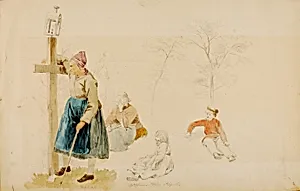
Peasant Figures
Medium
Drawing
Classification
Drawing
Department
Smithsonian Collection
Museum
Smithsonian American Art Museum
Credit
Smithsonian American Art Museum, Bequest of Martha F. Butler
Accession Number
1991.56.194
Rights
Public Domain
Tags
Art Historical Context
**Peasant Figures** (1862) is a delicate drawing by American artist Miner Kilbourne Kellogg capturing everyday life in the French coastal town of Saint-Valery-sur-Somme. Created during Kellogg's travels in Europe amid the American Civil War, this work reflects the 19th-century fascination with peasantry, a theme popularized by Realist artists like Jean-François Millet. Kellogg, trained in portraiture and known for his luminous landscapes and genre scenes, sketched these humble figures—likely including women in traditional attire—highlighting their quiet dignity against the backdrop of northern France's picturesque fishing village. As a pencil or ink drawing (typical of the medium's classification), the piece showcases Kellogg's skill in rapid, expressive lines that convey texture and movement, a technique honed during his European studies. Saint-Valery-sur-Somme, with its medieval abbey and marshy Somme estuary, provided vivid inspiration for such on-site studies, blending American artistic curiosity with French regional character. Now housed in the Smithsonian American Art Museum through the bequest of Martha F. Butler, *Peasant Figures* offers a window into transatlantic cultural exchange. It reminds visitors of how 19th-century artists romanticized the "simple life," preserving fleeting moments of human resilience in an era of global upheaval. (198 words)