
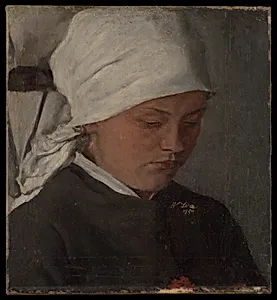
Peasant Girl with a White Headcloth
1885
Medium
Oil on canvas
Dimensions
9 7/8 x 9 1/8 in. (25.1 x 23.2 cm)
Classification
Paintings
Department
European Paintings
Museum
Metropolitan Museum of Art, New York, NY
Credit
Reisinger Fund, 1916
Accession Number
16.148.1
Rights
Public Domain
Tags
Art Historical Context
Wilhelm Leibl's *Peasant Girl with a Headcloth* (1885) is a captivating small-scale oil on canvas, measuring just 9⅞ × 9⅛ inches, inviting viewers into an intimate encounter with rural Bavarian life. Acquired by the Metropolitan Museum of Art through the Reisinger Fund in 6, this work exemplifies Leibl's mastery as a leading figure in 19th-century German Realism. Leibl, often compared to Gustave Courbet, rejected academic idealism to portray everyday peasants with unflinching honesty and profound dignity. Here, the girl's traditional white headcloth—symbolizing modesty and cultural heritage—frames her face, rendered with meticulous brushwork that captures the subtle textures of fabric and skin. His technique emphasizes direct observation, blending precise detail with a sense of quiet presence, characteristic of the Leibl-Kreis circle of artists who championed naturalism. This modest portrait holds cultural weight as a window into late-19th-century European rural identity, elevating ordinary subjects amid industrialization's rise. Its compact size suggests it may have been a study or personal sketch, underscoring Leibl's commitment to authenticity over grandeur. A gem in the Met's European Paintings collection, it reminds us of art's power to humanize the overlooked.
About the Artist
Wilhelm Leibl · 1844–1900
Wilhelm Leibl (1844–1900) was the foremost German Realist painter of the nineteenth century, a figure who dedicated his career to an uncompromising fidelity to observed reality at a time when idealized academic painting still dominated official taste. Born in Cologne, he studied at the Munich Academy under Karl von Piloty, but the decisive influence on his development came from his encounter with ...