
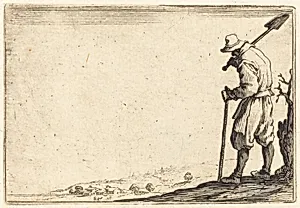
Peasant with Shovel on His Shoulder
c. 1622
Medium
etching on laid paper
Dimensions
plate: 5.3 × 7.9 cm (2 1/16 × 3 1/8 in.) sheet: 7.4 × 9.3 cm (2 15/16 × 3 11/16 in.)
Classification
Department
CG-E
Museum
National Gallery of Art, Washington, D.C.
Credit
R.L. Baumfeld Collection
Accession Number
1969.15.472
Rights
Public Domain
Art Historical Context
Jacques Callot's *Peasant with Shovel His Shoulder* (c. 1622) captures the humble dignity of rural life in a remarkably small etching on laid paper, measuring just5.3 × 7.9 cm on the plate. This French Baroque master, renowned for his intricate printmaking, depicts a weathered laborer striding forward with his tool, evoking the everyday struggles of 17th-century European peasantry amid economic hardships and social upheaval. Callot, who honed his skills in Florence and Nancy, excelled in genre scenes portraying beggars, soldiers, and common folk, often with empathetic detail. This work likely belongs to his early series of humble figures, showcasing his innovative etching technique—using fine needles and acid bites for dense cross-hatching that renders textures like rough clothing and determined expressions with astonishing precision in miniature format. As part of the National Gallery of Art's R.L. Baumfeld Collection, this print highlights etching's rise as a democratic medium, allowing widespread dissemination of vivid social commentary. Visitors will appreciate how Callot's artistry bridges grandeur and grit, inviting reflection on the lives of the overlooked.
About the Artist
Jacques Callot · 1592–1635
Jacques Callot (1592–1635) was a French printmaker and draftsman from the Duchy of Lorraine, widely regarded as one of the first great artists to practice the graphic arts exclusively. His more than 1,400 etchings chronicled the breadth of 17th-century life, from Medici court festivities to the brutal realities of warfare. Callot revolutionized etching through technical innovations including the é...