
Peasants Carrying Hay (Paysans portant du foin)
1900
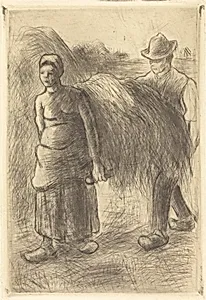
Medium
etching and drypoint
Classification
Department
CG-E
Museum
National Gallery of Art, Washington, D.C.
Credit
Rosenwald Collection
Accession Number
1943.3.7308
Rights
Public Domain
Art Historical Context
In the waning years of his career, Camille Pissarro, a father of Impressionism, created *Peasants Carrying HayPaysans portant duoin)* in 1900. This etching and drypoint captures the artist's enduring fascination with rural French life, portraying sturdy peasants laboring under heavy loads of hay—a motif drawn from his deep empathy for the working class. By 1900, Pissarro had shifted from his signature plein-air oil paintings to printmaking, producing over 150 etchings that allowed him to experiment with texture and tone while evoking the fleeting light and everyday toil of the countryside. The medium of etching and drypoint is particularly significant here. Etching involves drawing through a wax ground on a metal plate, which is then submerged in acid to etch fine lines; drypoint adds a direct, incised burr that yields velvety, rich textures ideal for suggesting the roughness of hay and fabric. This late work exemplifies Pissarro's innovative print techniques, blending precision with impressionistic spontaneity. Housed in the National Gallery of Art's Rosenwald Collection (Department CG-E), it reflects his lifelong commitment to democratizing art through affordable prints, bridging fine art and the masses just three years before his death in 1903. A poignant glimpse into turn-of-the-century rural France, it invites visitors to appreciate the dignity in simple labor.
About the Artist
Camille Pissarro · 1831–1903
Camille Pissarro (1830-1903) stands as the patriarch of Impressionism, the only artist to exhibit in all eight Impressionist exhibitions and a mentor whose influence shaped the trajectory of modern art. Born Jacob Abraham Camille Pissarro on the Caribbean island of St. Thomas to a Jewish-Portuguese merchant family, he abandoned the family business to pursue painting, eventually settling in Paris i...