
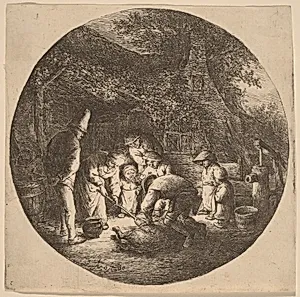
Peasants Outside a Farm Slaughtering a Pig
c. 1652
Medium
etching, with touches of drypoint, on laid paper
Dimensions
sheet (trimmed within plate mark): 11.5 × 11.6 cm (4 1/2 × 4 9/16 in.)
Classification
Department
CG-E
Museum
National Gallery of Art, Washington, D.C.
Credit
Rosenwald Collection
Accession Number
1943.3.8314
Rights
Public Domain
Art Historical Context
Adriaen van Ostade *Peasants Outside a Slaughtering a Pig*c. 1652) captures a gritty slice of 17th-century Dutch rural life during the Golden Age. As a master of genre scenes, van Ostade (1610–1685) specialized in depicting peasants with earthy realism, often infused with humor or pathos. Here, a group of villagers busily slaughters a pig outside a modest farm—a common winter ritual to preserve meat through salting or smoking, essential for survival in the harsh northern European climate. This intimate etching reflects the era's fascination with everyday activities, elevating humble laborers from mere background figures in grand history paintings to worthy subjects. Printed on laid paper, the work measures just 11.5 × 11.6 cm, inviting close viewing to appreciate van Ostade's virtuoso printmaking. He employed etching, where acid etches lines into a metal plate for precise, fluid strokes, enhanced by drypoint—a direct needle scratching that creates velvety burrs for rich texture and depth. These techniques, influenced by Rembrandt, lend a tactile immediacy, with shadows and expressions bursting with life despite the small scale. Housed in the National Gallery of Art's Rosenwald Collection, this print exemplifies Dutch Baroque genre art's cultural snapshot: a celebration of communal labor amid prosperity, reminding us of the rhythms of pre-industrial life. Visitors might linger on the vivid bustle, pondering how such scenes humanized the "lowly" in an age of artistic innovation.
About the Artist
Adriaen van Ostade · 1610–1685
Adriaen Jansz. van Ostade (1610-1685) was a Dutch Baroque painter and printmaker who specialized in genre scenes of peasant life. Born and raised in Haarlem, he became one of the most prolific and celebrated artists of the Dutch Golden Age, producing over 800 paintings, 50 etchings, and numerous drawings. Van Ostade's significance in art history lies in his masterful depiction of peasant life, a ...