
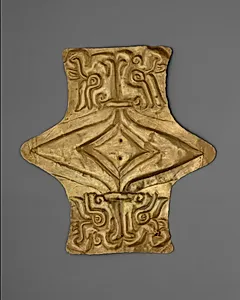
Pectoral
800–500 BCE
Medium
Gold
Dimensions
H. 9 × W. 9 1/4 × D. 1/8 in. (22.9 × 23.5 × 0.3 cm)
Classification
Metal-Ornaments
Culture
Chavín
Department
Arts of Africa, Oceania, and the Americas
Museum
Metropolitan Museum of Art, New York, NY
Credit
Jan Mitchell and Sons Collection, Gift of Jan Mitchell, 1999
Accession Number
1999.365
Rights
Public Domain
Art Historical Context
This exquisite gold pectoral, crafted by Chavín artists around 800–500 BCE, hails from the ancient Chavín culture of Peru's northern highlands. Measuring a delicate 9 by 9¼ inches, it served as a chest ornament, likely worn by elites or priests during religious ceremonies at influential sites like Chavín Huántar. As one of the earliest complex societies in the Andes, the Chavín unified diverse regional styles through shared religious iconography, blending human and animal forms into powerful supernatural motifs. Hammered from thin sheets of gold—a precious metal symbolizing the sun and divine power in Andean cosmology—this pectoral exemplifies Chavín mastery of metalworking. Techniques like repoussé (hammering from the reverse to create relief) allowed artists to depict intricate, stylized creatures such as jaguars, serpents, and raptors, evoking shamanic visions and the transformative power of hallucinogenic rituals. Its lightweight design (just ⅛ inch thick) ensured it draped elegantly over garments, amplifying the wearer's spiritual authority. Housed in The Metropolitan Museum of Art's Arts of Africa, Oceania, and the Americas department, this Jan Mitchell gift offers a window into Chavín's formative role in pre-Columbian art, bridging the Early Horizon period and foreshadowing later Andean gold traditions. A testament to innovation and reverence, it invites us to ponder the sacred adornments of a lost world.