
Pectoral cross
1900
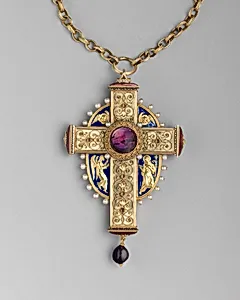
Medium
Yellow gold (750/1000 or 18-karat finenss), filigree work; opaque blue, black and white enamel, translucent dark red and transparent cream enamel; amethysts, citrine cabochons, chalcedony and pearls
Dimensions
Confirmed, cross only (integral bail-drop): 5 1/4 × 3 1/4 × 1 1/8 in. (13.4 × 8.3 × 2.8 cm) Overall length, confirmed: 35 1/8 in. (89.2 cm)
Classification
Metalwork-Gold and Platinum|Jewelry
Culture
German, Munich
Department
European Sculpture and Decorative Arts
Museum
Metropolitan Museum of Art, New York, NY
Credit
Gift of Stefan and Sylveli Hemmerle, 2018
Accession Number
2018.866
Rights
Public Domain
Art Historical Context
This exquisite pectoral cross, crafted by the renowned Munich jeweler Hemmerle in 1900, exemplifies the opulent metalwork of turn-of-the-century Germany. Measuring 5¼ × 3¼ × 1⅛ inches for the cross alone and extending to over 35 inches overall with its integral bail-drop, it was designed to be worn prominently on the chest, blending religious symbolism with jewelry artistry. Hemmerle, a prestigious firm from Munich, gifted this piece to the Metropolitan Museum of Art in 2018 family descendants Stefan and Sylveli, highlighting its enduring legacy. The cross showcases masterful filigree work in 18-karat yellow gold, adorned with a vibrant array of enamels—opaque blue, black, and white alongside translucent dark red and transparent cream—for a luminous, jewel-like depth. Precious stones including amethysts, citrine cabochons, chalcedony, and pearls add a touch of natural splendor, demonstrating advanced enameling and stone-setting techniques that elevated decorative arts in early 20th-century Europe. Housed in the Met's Department of European Sculpture and Decorative Arts, this German masterpiece reflects Munich's tradition of fine goldsmithing, where technical precision met aesthetic elegance. Visitors will appreciate its tactile richness and historical charm, a window into an era of lavish craftsmanship.