
Pedal Harp
second half 18th century
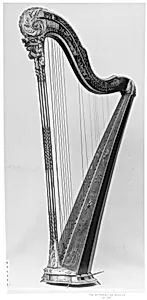
Medium
Wood, various materials
Dimensions
H. 156.5 cm (61 5/8 in.); Pillar length. 135.5 cm (53 3/8 in); Soundboard resonating length. 114 cm (44 7/8 in.); Soundboard greatest width 33 cm (13 in.); Strings sounding length: longest (approx.) 142 cm (55 7/8 in.), shortest 10 cm (3 15/16 in.); c2 30.5 cm (12 in.)
Classification
Chordophone-Harp
Culture
French
Department
Musical Instruments
Museum
Metropolitan Museum of Art, New York, NY
Credit
Gift of J. Pierpont Morgan, 1907
Accession Number
07.225.68
Rights
Public Domain
Art Historical Context
This elegant pedal harp, crafted by the French makers Renault & Chatelain in the second half of the eighteenth century, reflects the refined tastes of Enlightenment-era Europe. During this period, the harp evolved from a simple plucked instrument into a sophisticated concert favorite among the aristocracy. The addition of pedals allowed performers to change pitch quickly, enabling chromatic playing and broader musical expression without constant retuning. Constructed primarily of wood with various materials for its strings, soundboard, and mechanisms, the instrument measures over five feet tall, with a resonating soundboard spanning nearly 45 inches at its widest. Its graceful proportions and detailed craftsmanship highlight the blend of functionality and artistry prized by French luthiers. The harp’s design supported a rich tonal range, from the longest strings at approximately 142 centimeters to the shortest at just 10 centimeters. Now part of the Metropolitan Museum of Art’s musical instruments collection, this piece was generously gifted by J. Pierpont Morgan in 1907. It offers visitors a tangible connection to the musical culture of pre-Revolutionary France.