
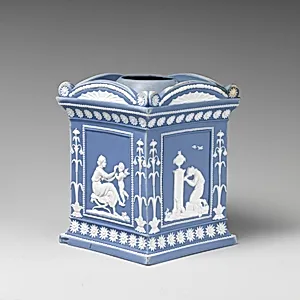
Pedestal
18th century
Medium
Jasperware
Dimensions
5 1/8 × 3 7/8 in. (13 × 9.8 cm)
Classification
Ceramics-Pottery
Culture
British, Staffordshire
Department
European Sculpture and Decorative Arts
Museum
Metropolitan Museum of Art, New York, NY
Credit
Rogers Fund, 1908
Accession Number
08.42.10a, b
Rights
Public Domain
Tags
Art Historical Context
In the heart of 18th-century Staffordshire, England—a cradle of British ceramic innovation—John Turner crafted this exquisite *Pedestal* in Jasperware, a fine, unglazed stoneware prized its smooth, matte finish and enduring durability. Measuring just 5 1/8 × 3 7/8 inches, this petite piece from the European Sculpture and Decor Arts collection at The Metropolitan Museum of Art (acquired via the Rogers Fund in 190) served as an elegant base for vases or figurines, embodying the era's neoclassical elegance in domestic interiors. Jasperware, pioneered by Josiah Wedgwood and masterfully replicated by rivals like Turner, allowed for intricate white bas-relief figures applied to a colored body, often in signature Wedgwood blue. Turner's version highlights delicate motifs of women, girls, and children, capturing the sentimental and graceful themes popular among the growing middle class. This technique not only showcased technical prowess—translucent effects achieved through precise firing—but also democratized luxury, turning pottery into high art. As a testament to Staffordshire's pottery rivalry and the Enlightenment's fascination with classical forms blended with everyday sentiment, this pedestal invites us to appreciate how ceramics bridged utility and beauty in Georgian Britain.