
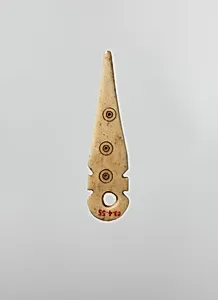
Peg for a Bookbinding
Unknown Artist
5th–7th century
Medium
Bone; incised and inlaid with paint
Dimensions
H. 2 7/16 in. (6.2 cm) W. 9/16 in. (1.5 cm) D. 3/16 in. (0.4 cm)
Classification
Ivories and Bone
Department
Islamic Art
Museum
Metropolitan Museum of Art, New York, NY
Credit
Gift of Egypt Exploration Fund, 1903
Accession Number
03.4.55
Rights
Public Domain
Art Historical Context
This delicate bone peg, crafted between the 5th and 7th centuries, a practical yet elegant purpose: securing the bindings of ancient books. Measuring just 2 7/16 inches tall, it exemplifies the exquisite craftsmanship of early Islamic or late antique Egypt, where everyday objects were transformed into miniature works of art. Donated to the Metropolitan Museum of Art in 1903 by the Exploration Fund, it now resides in the Islamic Art, highlighting the region's rich tradition of ivories and bone carving. During this transitional era—from Byzantine and Coptic influences to the dawn of Islam—bookbinding held profound cultural weight. Codices, precursors to modern books, were essential for preserving religious texts like Christian scriptures or emerging Islamic writings. Such pegs ensured durability, reflecting a society's reverence for knowledge and the written word. Artistically, the peg's surface features intricate incisions filled with colorful paint inlays, a sophisticated technique that added vibrancy and depth to the smooth bone. This method not only enhanced durability but also allowed for subtle decoration, blending utility with aesthetic refinement in a time when portability and preservation were paramount. A testament to anonymous artisans' skill, it invites us to appreciate the hidden artistry in history's functional treasures.