
Pellet and Bolt Crossbow Combined with a Wheel-Lock Gun
ca. 1570–1600
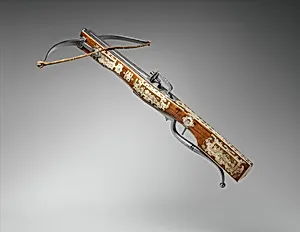
Medium
Steel, wood (cherry), staghorn, hemp, felt
Dimensions
L. 28 1/2 in. (72.4 cm); W. 26 1/2 in. (67.2 cm); Wt. 11 lb. 7 oz. (5,197 g)
Classification
Archery Equipment-Crossbows
Culture
Central European; possibly Southern German or Austrian
Department
Arms and Armor
Museum
Metropolitan Museum of Art, New York, NY
Credit
Gift of William H. Riggs, 1913
Accession Number
14.25.1573
Rights
Public Domain
Art Historical Context
This remarkable hybrid weapon, created by the Central European craftsman Jacob Floris around 1570–1600, represents a fascinating moment of technological transition in military history. Combining a pellet-and-bolt crossbow with a wheel-lock gun, it allowed its user to choose between traditional archery and the emerging power of firearms. Likely produced in southern Germany or Austria, such multifunctional arms were prized by noble collectors and soldiers alike during the late Renaissance, when gunpowder technology was rapidly evolving yet still unreliable in the field. The piece’s construction highlights both ingenuity and artistry. Its steel components, cherry wood stock, staghorn inlays, and hemp cord demonstrate the careful integration of durable materials with decorative elements typical of high-status arms of the period. The wheel-lock mechanism, one of the earliest self-igniting firing systems, adds another layer of sophistication, reflecting the era’s growing interest in mechanical innovation. Housed in the Metropolitan Museum of Art’s Arms and Armor collection, this crossbow-gun offers visitors a tangible connection to the shifting battlefields of early modern Europe. Its elegant form reminds us that weapons of the time were often as much statements of craftsmanship as tools of war.