
Pendant
Unknown Artist
first quarter 16th century
Medium
Gold, reverse-painted; rock crystal
Dimensions
Overall: 3 × 2 in. (7.6 × 5.1 cm)
Classification
Metalwork-Gold and Platinum|Jewelry
Culture
Northern Italian, Lombardy
Department
European Sculpture and Decorative Arts
Museum
Metropolitan Museum of Art, New York, NY
Credit
Gift of J. Pierpont Morgan, 1917
Accession Number
17.190.884
Rights
Public Domain
Tags
Art Historical Context
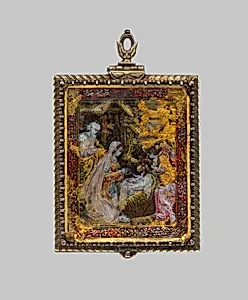
This exquisite pendant, crafted in the first quarter of the16th century by an unknown Northern Italian artisan from Lombardy, captures the Renaissance fascination with intricate jewelry and devotional imagery. Measuring just 3 × 2 inches, it features a Nativity scene—depicting infants, men, and women in a tender moment of Christ's birth—rendered through a rare technique of reverse-painting on rock crystal, set in gleaming gold. Rock crystal, a clear quartz prized for its transparency, allowed the painted details on the reverse side to shine vividly from the front, creating a luminous, jewel-like effect perfect for personal wear. Hailing from Lombardy, a hub of Renaissance goldsmithing and metalwork, this piece reflects the era's blend of technical virtuosity and religious piety. Northern Italian workshops excelled in such micro-mosaics and enamels, making pendants like this not just adornments but intimate prayer objects for the devout elite. The gold frame enhances its luxury, underscoring the period's opulent patronage of the arts. A generous gift to the Metropolitan Museum of Art from J. Pierpont Morgan in 1917, this pendant invites us to marvel at the delicate skill of anonymous makers whose work bridged art and faith in Renaissance Italy.