
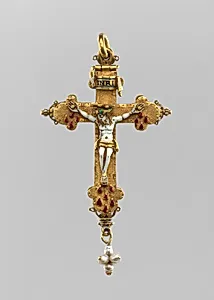
Pendant
Unknown Artist
probably 17th–18th century
Medium
Gold, enamel, pearls
Dimensions
Overall: 3 1/8 × 1 3/4 in. (7.9 × 4.4 cm)
Classification
Metalwork-Gold and Platinum|Jewelry
Culture
European
Department
European Sculpture and Decorative Arts
Museum
Metropolitan Museum of Art, New York, NY
Credit
The Friedsam Collection, Bequest of Michael Friedsam, 1931
Accession Number
32.100.307
Rights
Public Domain
Tags
Art Historical Context
This exquisite gold pendant, likely crafted in Europe during the 17th 18th century, the poignant scene of Christ's Crucifixion. Measuring just 3 1/8 × 1 3/4 inches, it served as a personal devotional object, worn close to the heart by its owner as a symbol of faith and piety. In an era when religious imagery permeated daily life, such jewelry pieces bridged the sacred and the intimate, offering spiritual protection and reminding wearers of Christ's sacrifice amid the grandeur of Baroque or early Rococo aesthetics. Masterfully combining gold, enamel, and pearls, the pendant showcases virtuoso metalworking techniques. The lustrous gold frame provided durability and opulence, while translucent or painted enamel—fired onto the metal in intricate layers—brought vivid life to the Crucifixion scene, with pearls adding a touch of divine radiance symbolizing purity and tears of the Virgin. These luxurious materials underscored the wearer's status, blending artistry with devotion in the tradition of European goldsmiths. Now part of The Friedsam Collection at The Metropolitan Museum of Art, gifted in 1931, this anonymous treasure invites us to reflect on how everyday adornments carried profound spiritual weight in centuries past. A testament to enduring faith, it gleams as both jewelry and sacred icon.