
Pendant
Unknown Artist
Medium
Nephrite
Dimensions
H. 2 1/16 in. (5.3 cm); W. 1 5/16 in. (3.3 cm); D. 11/16 in. (1.8 cm)
Classification
Jade
Culture & Period
China · Qing dynasty (1644–1911), Jiaqing period (1796–1820)
Department
Asian Art
Museum
Metropolitan Museum of Art, New York, NY
Credit
Gift of Heber R. Bishop, 1902
Accession Number
02.18.708
Rights
Public Domain
Tags
Art Historical Context
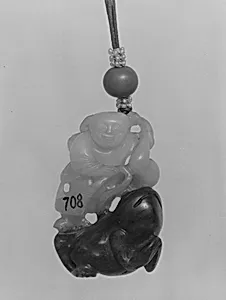
This delicate nephrite jade pendant, during China's Qing dynasty in the Jiaqing period (6–1820), the era's masterful jade carving tradition. Measuring just over 2 inches high, its petite form—ideal for personal adornment—suggests it was worn as jewelry, perhaps suspended from a belt or necklace. The smooth, translucent nephrite, a prized form of jade revered in Chinese culture for its purity and durability, was meticulously shaped into a scene featuring animals and men, evoking harmony between humanity and nature, a common motif in imperial art. Jade pendants like this held profound cultural significance, symbolizing status, protection, and moral virtue among the elite. During the Qing era, under Emperor Jiaqing, workshops refined techniques like incising and polishing to capture intricate details, highlighting the stone's natural veining for lifelike texture. Though the artist remains unknown, such works reflect the pinnacle of artisanal skill fostered by the court. Now at the Metropolitan Museum of Art, thanks to a 1902 gift from Heber R. Bishop, this pendant invites us to appreciate the timeless elegance of Qing jade craftsmanship, bridging personal devotion with artistic excellence.