
Pendant
Unknown Artist
9th–19th century
Medium
Striated glass
Dimensions
H. 1 3/8 in. (3.5 cm) W. 5/8 in. (1.6 cm) D. 5/16 in. (0.8 cm)
Classification
Glass
Department
Islamic Art
Museum
Metropolitan Museum of Art, New York, NY
Credit
Gift of Helen Miller Gould, 1910
Accession Number
10.130.2825c
Rights
Public Domain
Tags
Art Historical Context
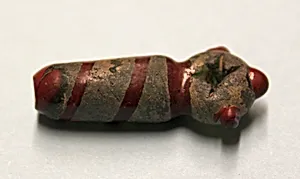
This delicate pendant, crafted from striated glass, exemplifies the refined artistry of Islamic glassmakers across a vast chronological span from the 9th to 19th century. Measuring just 1⅜ inches high, ⅝ inch wide, and 5⁄16 inch deep, its petite form suggests it was worn as personal adornment—perhaps suspended from a chain or cord as jewelry or an amulet. The striated technique, featuring colorful streaks or veins within the glass, creates a mesmerizing mar effect, highlighting the skill of artisans who manipulated molten glass to achieve such vibrant patterns without modern tools. In the Islamic world, glassworking flourished in centers like Syria, Egypt, and Persia, where pendants like this served both decorative and talismanic purposes, often invoking protection or good fortune. Though the exact origin and maker remain unknown, the broad date range reflects enduring traditions in Islamic art, where glass was prized for its luminosity and affordability compared to precious metals. Techniques like striation demonstrate innovative cold-working methods post-firing, blending utility with aesthetic beauty. Generously gifted to the Metropolitan Museum of Art by Helen Miller Gould in 1910, this pendant invites visitors to ponder the intimate lives of wearers long ago, bridging centuries of cultural continuity in the Department of Islamic Art.