
Pendant
Unknown Artist
6th–7th century
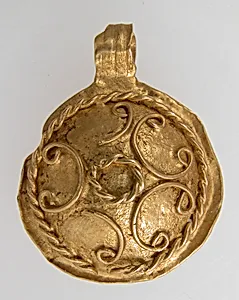
Medium
Gold
Dimensions
Overall: 1 x 13/16 x 3/8 in., 0.1oz. (2.6 x 2 x 0.9 cm, 4g)
Classification
Metalwork-Gold
Culture
Langobardic
Department
Medieval Art
Museum
Metropolitan Museum of Art, New York, NY
Credit
Gift of J. Pierpont Morgan, 1917
Accession Number
17.191.30
Rights
Public Domain
Art Historical Context
This delicate gold pendant, crafted by an unknown Langobardic artisan in the 6th–7th century, exemplifies the metalwork of early medieval Europe. Measuring just 1 x 13/16 x 3/8 inches and weighing a mere 0.1 ounce, its petite scale belies its luxurious material—pure gold, symbolizing wealth and status among the Lombards, a Germanic people who established a kingdom in Italy after migrating from the north around 568 CE. As part of the Metropolitan Museum of Art's Medieval collection, it was generously gifted by J. Pierpont Morgan in 1917, highlighting its enduring allure. Langobardic goldsmiths were masters of fine techniques, likely employing hammering, chasing, and filigree to create intricate jewelry that blended Germanic traditions with influences from the late Roman world and Byzantium. Pendants like this were worn as personal adornments, possibly as amulets or symbols of identity, reflecting the turbulent yet culturally vibrant Migration Period. Its survival speaks to the Lombards' skill in producing durable, ornate objects that bridged pagan and emerging Christian eras. Today, this tiny treasure offers a window into daily life under Lombard rule, reminding us how portable art conveyed power and piety in an age of conquest and craftsmanship.