
Pendant
Unknown Artist
early 600s
Medium
Gold with garnets
Dimensions
Overall: 1 1/8 x 1/16 x 1/16 in. (2.8 x 0.2 x 0.1 cm) With Attachment: 1 1/8 x 1 3/16 in. (2.8 x 3 cm)
Classification
Metalwork-Gold
Culture
Anglo-Saxon
Department
Medieval Art
Museum
Metropolitan Museum of Art, New York, NY
Credit
Purchase, Joseph Pulitzer Bequest, 1987
Accession Number
1987.90.2
Rights
Public Domain
Art Historical Context
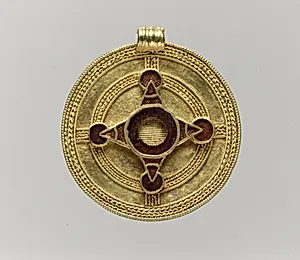
This exquisite gold pendant, crafted in the early 600 by an unknown Anglo-Saxon artisan, showcases the masterful metalwork of early medieval England. Measuring just over an inch in height, its delicate form—adorned with inlaid garnets—suggests it was worn as personal jewelry, perhaps as a neck ornament or amulet. The use of gold, a rare and precious material, combined with vibrant red garnets, highlights wealth and status of its during the Anglo-Saxon period, a time of tribal kingdoms and emerging Christian influences. Anglo-Saxon jewelers were renowned for their intricate techniques, often employing cloisonné-style settings where thin gold wire cells held polished garnet stones, creating a luminous, gem-like effect. This pendant, now in the Metropolitan Museum of Art's Medieval Art collection (acquired through the Joseph Pulitzer Bequest in 1987), reflects the cultural fusion of Germanic artistry and Roman-inspired opulence from the Migration Age. Such pieces were not merely decorative but symbols of power and protection. Visitors will appreciate how this tiny treasure captures the sophistication of Anglo-Saxon craftsmanship, bridging pagan traditions and the dawn of monastic metalworking that would flourish in later centuries like those at Sutton Hoo.