
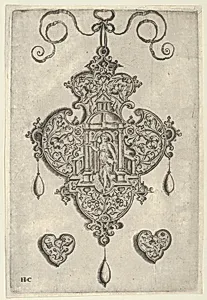
Pendant Design with Faith Standing in a Circular Temple
before 1573
Medium
Engraving; first state of two (New Hollstein)
Dimensions
Sheet: 5 13/16 × 4 1/16 in. (14.8 × 10.3 cm)
Classification
Ornament & Architecture|Prints
Department
Drawings and Prints
Museum
Metropolitan Museum of Art, New York, NY
Credit
Rogers Fund, 1922
Accession Number
22.113.25
Rights
Public Domain
Tags
Art Historical Context
This exquisite engraving, titled *Pendant Design with Faith Standing in Circular Temple*, is a jewel of Renaissance ornamentation, created before 1573 by either Collaert I, a prominent Flemish engraver known for intricate reproductive prints, or Hans Liefrinck, a Dutch master of architectural motifs. Measuring just 5 13/16 × 4 1/16 inches, this first-state impression from the New Hollstein catalog captures the precision of 16th-century engraving techniques, where fine lines etched into copper plates allowed for exceptional detail in jewelry designs. Housed in the Metropolitan Museum of Art's Drawings and Prints department (acquired via Rogers Fund, 1922), it exemplifies the era's fusion of art and wearable luxury. At its heart, the composition depicts the allegorical figure of Faith poised gracefully within a circular temple, surrounded by floral elements that evoke piety and natural beauty. Such pendant designs were highly sought after in the Renaissance, serving as both personal talismans and status symbols for the elite, blending religious symbolism with architectural fantasy. The circular temple nods to classical influences revived during the period, symbolizing eternity and divine enclosure. As a rare early state, this print holds special appeal for collectors, showcasing the engraver's mastery before later states introduced wear or alterations. It invites us to appreciate how Renaissance artists like Collaert or Liefrinck transformed ephemeral sketches into enduring blueprints for devotion and adornment.