
Pendant in the form of a ship
probably late 19th century
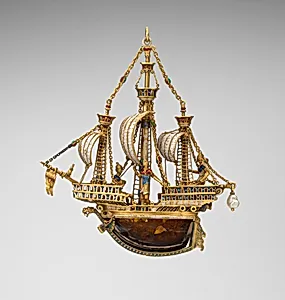
Medium
Gold, partly enameled and set with gems; baroque pearl; rock crystal
Dimensions
Overall: 4 3/8 × 3 3/4 in. (11.1 × 9.5 cm)
Classification
Metalwork-Gold and Platinum|Jewelry
Culture
French, Paris
Department
European Sculpture and Decorative Arts
Museum
Metropolitan Museum of Art, New York, NY
Credit
The Friedsam Collection, Bequest of Michael Friedsam, 1931
Accession Number
32.100.312
Rights
Public Domain
Tags
Art Historical Context
This exquisite pendant, crafted by Parisian jeweler Alfred André in late 19th century takes the form of a majestic ship, evoking the of maritime exploration during an era of global voyages and naval innovation. Measuring about 4⅜ × 3¾ inches, it exemplifies the opulent jewelry traditions of fin-de-siècle Paris, goldsmiths like André blended technical mastery with whimsical naturalism. Housed in the Metropolitan Museum of Art's European Sculpture and Decorative Arts department as part of The Friedsam Collection, it captures the height of French luxury metalwork. André's design showcases virtuoso techniques: finely wrought gold forms the ship's hull and rigging, enhanced by partial enameling for vibrant color and subtle sheen. Pearls—particularly the irregular, highly prized baroque pearl—serve as sails or waves, while faceted gems add sparkle and rock crystal provides translucent clarity, mimicking sea foam or glass elements. These materials highlight the jeweler's skill in integrating organic irregularity with polished precision, a hallmark of late 19th-century ornamental arts. As wearable art, the pendant reflects France's cultural fascination with ships as symbols of adventure and empire, worn by elite women at grand soirées. Its survival in museum collections underscores the enduring allure of such intricate, narrative jewelry, bridging personal adornment and sculptural storytelling.