
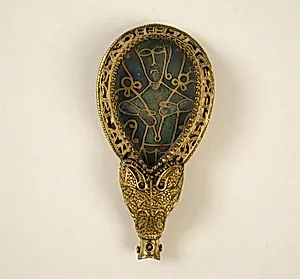
Pendant Jewel with Alfred the Great
Unknown Artist
19th century (?; original dated 9th century)
Medium
Gold, enamel, rock crystal
Dimensions
Overall: 2 7/16 x 1 1/4 x 1/2in. (6.2 x 3.2 x 1.3cm)
Classification
Reproductions-Enamels
Culture
Saxon
Department
Medieval Art
Museum
Metropolitan Museum of Art, New York, NY
Credit
Gift of Samuel P. Avery, 1901
Accession Number
01.26
Rights
Public Domain
Tags
Art Historical Context
This delicate pendant jewel, featuring the likeness of Alfred the Great is a 19th-century reproduction of rare 9th-century Saxon. Crafted in shimmering gold with vibrant enamel and a protective rock crystal cover, it measures just over 2 inches tall, embodying the intricate jewelry traditions of early medieval England. Housed in the Metropolitan Museum of Art's Medieval department, it entered the collection as a gift from Samuel P. Avery in1901. Alfred the Great (r. 871–899), the revered King of Wessex, is celebrated here in enamel portraiture—a technique where powdered glass is fused to metal in vivid colors, often under a transparent crystal dome for durability and luster. This method highlights the technical prowess of Saxon artisans, who blended Christian iconography with royal symbolism during a turbulent era of Viking invasions. Such pendants served as both personal adornments and emblems of loyalty to the king who unified disparate Anglo-Saxon kingdoms and championed learning. Though a reproduction, this piece offers a tangible link to Alfred's legacy, inviting visitors to ponder the artistry and resilience of Saxon culture. Its compact elegance reveals how medieval jewelers compressed history into wearable treasures.