
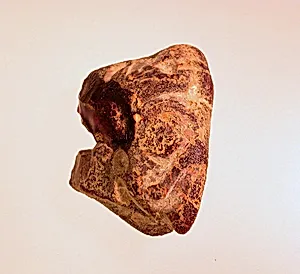
Pendant: satyr's head
Unknown Artist
5th century BCE
Medium
Amber
Dimensions
2 3/16 × 1 9/16 × 1 1/8 in. (5.5 × 4 × 2.9 cm)
Classification
Miscellaneous-Amber
Culture & Period
Italic · Classical
Department
Greek and Roman Art
Museum
Metropolitan Museum of Art, New York, NY
Credit
Gift of Mr. and Mrs. Jonathan P. Rosen, 1992
Accession Number
1992.267.4
Rights
Public Domain
Tags
Art Historical Context
This exquisite amber pendant, depicting a satyr's head, dates to the 5th century BCE during the Classical period. Crafted by an unknown Italic artist—likely from central or southern Italy—it measures just over 2 inches tall, perfect for personal adornment as jewelry or an amulet. Satyrs, those mischievous half-man, half-goat figures from Greek mythology, embody revelry, fertility, and the wild spirit of Dionysian rites, suggesting cultural exchanges between Greek colonists and Italic peoples. Amber, a fossilized tree resin sourced from distant Baltic trade routes, was a luxury material in antiquity, prized for its warm golden glow and rarity. Carving it demanded exceptional skill, as the soft material could crack under pressure; the detailed facial features—bearded face, pointed ears, and lively expression—highlight the artisan's mastery. In Italic contexts, such pendants might have served protective or apotropaic purposes, warding off evil while celebrating life's exuberant forces. Today, this rare gem resides in the Metropolitan Museum of Art's Greek and Roman Art department, a gift from Mr. and Mrs. Jonathan P. Rosen in 1992. Imagine wearing it close to your heart, a tangible link to ancient Mediterranean vitality!