
Pendant
1600-1700
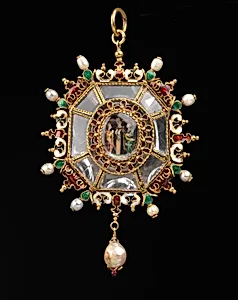
Medium
Decorative Arts-Jewelry
Classification
Decorative Arts-Jewelry
Department
Smithsonian Collection
Museum
Smithsonian American Art Museum
Credit
Smithsonian American Art Museum, Gift of John Gellatly
Accession Number
1929.8.192
Rights
Public Domain
Tags
Art Historical Context
This exquisite pendant, dating from 1600-1700, exemplifies the intricate world of early jewelry as a form of personal devotion. Crafted by an unidentified artist, it features a motif depicting Christ and the Crucifixion, transforming a wearable adornment into a poignant religious symbol. Such pieces were common in the Baroque era, blending artistry with faith, and likely served as both a talisman for protection and a statement of piety for its wearer. As a prime example of decorative arts in jewelry, the pendant highlights the technical mastery of the period, where metalsmiths employed enameling, engraving, or filigree to evoke spiritual depth on a small scale. Its presence in the Smithsonian American Art Museum's collection, gifted by John Gellatly, underscores its value in American art history—possibly an import or early colonial artifact reflecting Europe's influence on New World culture during a time of religious fervor and exploration. Visitors will appreciate how this unassuming jewel encapsulates 17th-century spirituality, reminding us that art was often intimate and ever-present in daily life. A testament to enduring faith, it invites reflection on the personal role of sacred objects.
About the Artist
Unidentified ( ) · –