
Pendants
Unknown Artist
20th century
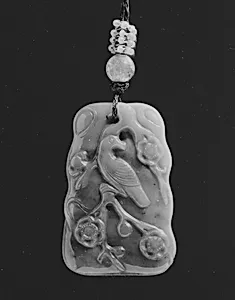
Medium
Jade, seed pearls
Dimensions
W. 1 3/8 in. (3.5 cm); L. 2 1/4 in. (5.7 cm)
Classification
Jade
Culture
China
Department
Asian Art
Museum
Metropolitan Museum of Art, New York, NY
Credit
Alfred W. Hoyt Collection, Bequest of Rosina H. Hoppin, 1965
Accession Number
65.86.102
Rights
Public Domain
Tags
Art Historical Context
These delicate jade pendants, crafted in 20th-century, exemplify the enduring tradition of jade carving in Asian art. Measuring just 1 3/8 inches wide and 2 1/4 inches long, these jewels—adorned with seed pearlswere likely worn as personal ornaments, showcasing the wearer's appreciation for refined elegance and natural motifs. The unknown artist skillfully transformed translucent jade, a material revered in Chinese culture for its purity and symbolic ties to immortality and virtue, into intricate designs featuring birds, which often represent freedom, good fortune, or seasonal harmony. Jade's significance in China spans millennia, from ancient ritual objects to modern luxury items, and these pendants reflect that legacy into the early 20th century. The use of seed pearls adds a subtle luster, enhancing the jade's cool glow and demonstrating advanced techniques in piercing, polishing, and inlay. Part of the Metropolitan Museum of Art's Asian Art collection, gifted through the Alfred W. Hoyt Collection in 1965, they invite us to ponder the artistry of everyday beauty in a turbulent era of Chinese history. (178 words)