
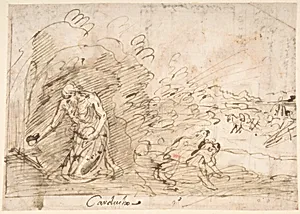
Penitent St. Jerome (recto); Notes and Accounts (verso)
Medium
Pen and brown ink (recto and verso)
Dimensions
5-9/16 x 8 in. (14.1 x 20.3 cm)
Classification
Drawings
Department
Drawings and Prints
Museum
Metropolitan Museum of Art, New York, NY
Credit
Bequest of Harry G. Sperling, 1971
Accession Number
1975.131.207
Rights
Public Domain
Tags
Art Historical Context
This delicate drawing by the Italian-born brothers Bartolomé and Vicente Carducho, created around 1600, captures the Penitent St. Jerome on recto—a revered saint depicted in ascetic contemplation amid a rocky desert landscape. Jerome, one of the four great Doctors of the Church, is shown in a classic pose of repentance, often with a skull and crucifix symbolizing mortality and redemption. The verso reveals a practical surprise: the artists' own notes and accounts, highlighting how Renaissance and early Baroque draftsmen thriftily reused sheets for both art and daily business. Executed in pen and brown ink on a modest 5-9/16 x 8-inch sheet, the work exemplifies the Carduchos' Mannerist style—characterized by fluid lines, intricate hatching for shadow and texture, and expressive figural poses influenced by their Florentine training. Having relocated to Spain, where Vicente became a key court painter under Philip III and IV, the brothers bridged Italian elegance with Spanish spirituality. This drawing, likely a preparatory study or devotional sketch, underscores the era's fusion of religious fervor and artistic economy. Housed in the Metropolitan Museum of Art's Drawings and Prints department through the bequest of Harry G. Sperling in 1971, it offers visitors a glimpse into the intimate creative process of early modern masters, blending sacred iconography with the human touch of everyday life.
About the Artist
Bartolomé Carducho|Vicente Carducho (Spanish|Italian) · 1560 |1570 –1608 |1638
Spanish, Florence ca. 1560–1608 Madrid|Italian, 1570/78–1638