
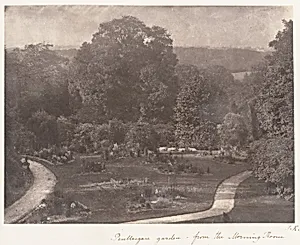
Penllergare Garden From the Morning Room
1853–56
Medium
Albumen silver print
Dimensions
Image: 15.2 × 20.2 cm (6 in. × 7 15/16 in.)
Classification
Photographs
Department
Photographs
Museum
Metropolitan Museum of Art, New York, NY
Credit
Gilman Collection, Gift of The Howard Gilman Foundation, 2005
Accession Number
2005.100.382 (59)
Rights
Public Domain
Tags
Art Historical Context
Step into the serene world of mid-19th-century Wales with *Penllergare Garden From Morning Room*, a captivating albumen silver print by Knight, created between 1853 and 1856. This intimate photograph peers out from the morning room of the Penllergare estate framing the lush gardens and rolling landscapes beyond. Knight, an early practitioner of photography, masterfully captures the picturesque beauty of this Victorian-era haven, where manicured lawns and wooded vistas evoke the Romantic ideal of nature's harmony. The albumen silver print, a hallmark of 1850s photography, uses a coating of egg whites on paper to produce richly toned images with exceptional detail and luminosity. This medium was revolutionary, allowing photographers like Knight to rival traditional paintings in precision while documenting fleeting outdoor scenes with unprecedented fidelity. At just 15.2 × 20.2 cm, the print's modest scale invites close contemplation, highlighting delicate foliage and atmospheric depth. Housed in the Metropolitan Museum of Art's Gilman Collection, this work exemplifies photography's swift evolution from novelty to art form. It offers a window into elite garden culture, blending architectural intimacy with natural splendor, and reminds us how early photographers transformed everyday views into timeless treasures.
About the Artist
James Knight
James Knight was a British artist active during the mid-nineteenth century, best known for his work as a photographer producing salted paper prints. His identity remains somewhat elusive in historical records, though he is documented as working in Britain during the 1850s and 1860s. No details of his early life, formal training, or artistic mentors have been identified in available sources. Knigh...