
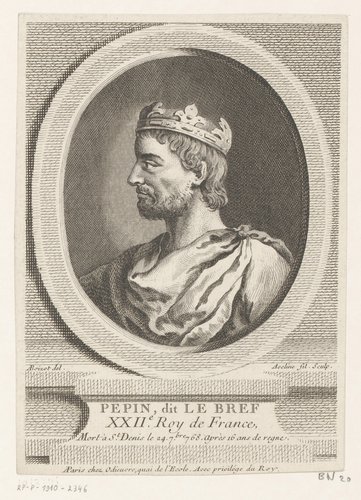
Pepin, dit le bref (...)
Medium
engraving
Dimensions
142; 103
Rights
Public Domain
About this artwork
Prent uit: Dreux du Radier, Jean-François. L'Europe illustré, contenant l'histoire abregée des souverains, des princes, des prélats, des ministres, (...) en Europe: dans le XVe. siècle compris, jusqu'à présent. Parijs: Michel Odieuvre en André-François Le Breton, 1755, dl. 1.
Art Historical Context
This delicate engraving, titled *Pepin, dit le* (Pepin the Short), was created by François-Antoine Aveline in 1755. Measuring just 142 mm high by 103 mm wide, it captures the likeness of Pepin III, the 8th-century Frankish king who deposed the Merovingians and became the first Carolingian ruler—father to Charlemagne. As a small-scale print, it exemplifies the precision of 18th-century French engraving techniques, where intricate lines and shading brought historical figures to life on the page. Featured in Jean-François Dreux du Radier's ambitious *L'Europe illustré*, volume 1 (published in Paris by Michel Odieuvre and André-François Le Breton), this artwork served as a visual aid in a comprehensive history of Europe's sovereigns, princes, prelates, and ministers from the 15th century onward. Such illustrated encyclopedias were Enlightenment-era treasures, making complex histories accessible to educated readers through affordable, reproducible prints. Aveline's mastery of burin work highlights engraving's role in disseminating knowledge during the Ancien Régime, blending artistry with scholarship. For visitors, it offers a window into how 18th-century Europeans romanticized medieval power, immortalizing Pepin in fine detail for posterity.