
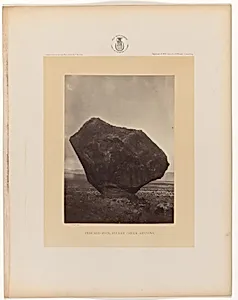
Perched Rock, Rocker Creek, Arizona
Medium
Albumen silver print from glass negative
Dimensions
Image: 10 7/8 × 8 1/16 in. (27.6 × 20.5 cm) Sheet: 21 7/16 in. × 16 in. (54.4 × 40.6 cm)
Classification
Photographs
Department
Photographs
Museum
Metropolitan Museum of Art, New York, NY
Credit
Gift of Joyce F. Menschel, 2015
Accession Number
2015.778.37
Rights
Public Domain
Art Historical Context
In 1872, photographer William Bell captured *Perched Rock, R Creek, Arizona* during George Montague Wheeler's U.S. Army survey expeditions (1869–1879). These missions mapped the uncharted American Southwest, blending scientific exploration with visual documentation amid post-Civil War westward expansion. Bell's image showcases a precariously balanced boulder in Arizona's rugged terrain, emblematic of the region's dramatic geology and the era's fascination with Manifest Destiny. Printed as an albumen silver from a glass negative—a 19th-century technique prized for its rich tonal depth and fine detail—this photograph measures 10 7/8 × 8 1/16 inches. Albumen prints, coated with egg whites for a glossy sheen, were the gold standard for reproducing expedition views, allowing crisp landscapes to be shared in reports and albums back East. Bell's straightforward composition highlights nature's grandeur without human intrusion, influencing later photographers like Ansel Adams. Today, at The Metropolitan Museum of Art (gift of Joyce F. Menschel, 2015), this work offers a window into America's vanishing frontier, reminding visitors of photography's power to preserve ephemeral wonders.
About the Artist
Lieutenant George Montague Wheeler|William Bell (American, born England|American) · 1831 |1842 –1910 |1905
American (born England), Liverpool 1831–1910 Philadelphia, Pennsylvania|American, 1842–1905