
Perfume Bottle
Unknown Artist
1830–70
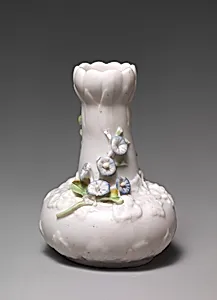
Medium
Parian porcelain
Dimensions
H. 4 1/8 in. (10.5 cm); Diam. 3 in. (7.6 cm)
Classification
Perfume bottle
Culture
American
Department
The American Wing
Museum
Metropolitan Museum of Art, New York, NY
Credit
Gift of Dr. Charles W. Green, 1947
Accession Number
47.90.45
Rights
Public Domain
Tags
Art Historical Context
This delicate perfume bottle, in Parian porcelain between 1830 and 1870, exemplifies the refined decorative arts of mid-19th-century America Standing just over 4 inches tall with a 3-inch diameter, its unglazed, matte-white surface mimics the translucent glow of Parian marble from the Greek island of Par—hence the name. Popularized in the 1840s by British potters and quickly adopted in American manufactories like those in Bennington, Vermont, or East Liverpool, Ohio, Parian porcelain allowed artisans to create elegant, biscuit-fired objects that rivaled marble sculpture in sophistication without the weight or cost. Housed in The Metropolitan Museum of Art's American Wing, this piece reflects the Victorian era's fascination with floral motifs, likely adorning its surface with delicate blossoms that evoke the period's romantic sensibility. Perfume bottles like this were cherished vanity items for affluent women, blending functionality with artistry in an age when personal grooming became a marker of gentility. Gifted to the museum in 1947 by Dr. Charles W. Green, it offers a glimpse into everyday luxury, highlighting how American potters innovated European techniques to produce accessible yet exquisite wares for the growing middle class.