
Perfume burner (one of a pair)
probably ca. 1770
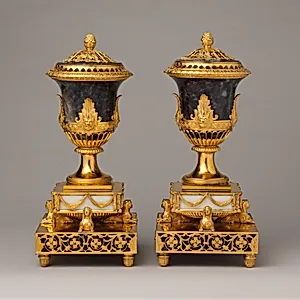
Medium
Derbyshire spar, tortoiseshell, and wood; Carrara marble base, gilded brass mounts, gilded copper liner
Dimensions
wt. confirmed: 13 × 5 5/8 × 5 5/8 in., 11.6 lb. (33 × 14.3 × 14.3 cm, 5.3 kg)
Classification
Metalwork-Gilt Bronze
Culture
British, Soho near Birmingham
Department
European Sculpture and Decorative Arts
Museum
Metropolitan Museum of Art, New York, NY
Credit
Gift of Irwin Untermyer, 1964
Accession Number
64.101.1633
Rights
Public Domain
Tags
Art Historical Context
This exquisite perfume burner, one of a pair crafted around 1770 by Matthew Boulton and James Fother, exemplifies the pinnacle of British luxurywork from the Soho Manufactory near Birmingham. During the late 18th century,ton's innovative firm revolutionized decorative arts, blending industrial precision with neoclassical elegance to supply Europe's elite. These objects reflect the era's fascination with ancient motifs, likely featuring sphinxes as tags suggest, evoking Egypt's mystique amid the Enlightenment's classical revival. Fashioned from Derbyshire spar—a shimmering, rare fluorite from England's Peak District—tortoiseshell, and wood, it rests on a Carrara marble base with gilded brass mounts and a copper liner. At 13 inches tall and weighing over 11 pounds, its substantial form highlights masterful techniques like gilding and inlay, creating a vessel that both diffused fragrant scents and served as a sculptural ornament. The opulent materials underscore Boulton's expertise in high-end gilt bronze, bridging utility and artistry. Housed in The Metropolitan Museum of Art's European Sculpture and Decorative Arts department (gift of Irwin Untermyer, 1964), this piece captures Birmingham's role as an industrial powerhouse, transforming raw innovation into timeless refinement for 18th-century drawing rooms.