
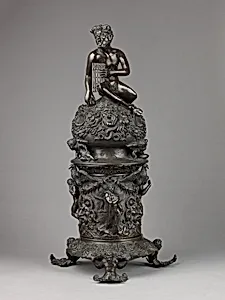
Perfume Burner Surmounted by a Satyr
ca. 1540–50
Medium
The cover and body are binary bronze (copper and tin, with traces of zinc, iron, nickel, silver, and antimony); the foot is cast in brass (copperzinc alloy with very minor amounts of tin, lead, and the usual copper impurities of iron, nickel, silver, and antimony).
Dimensions
H. overall 46.5 cm, h. of base 6.9 cm, h. of middle section, including bajonet joint 15.1 cm, h. of cover 25.7 cm.
Classification
Metalwork-Bronze
Department
Robert Lehman Collection
Museum
Metropolitan Museum of Art, New York, NY
Credit
Robert Lehman Collection, 1975
Accession Number
1975.1.1397
Rights
Public Domain
Tags
Art Historical Context
In the mid-16th century, sculptor Desiderio da crafted this exquisite *Perfumeer Surmounted by a Satyr* 1540–50, exemplifying the Renaissance fascination with mythological motifs and luxurious functional art. Perched atop the burner is a lively satyr—a mischievous, half-human, half-goat figure from mythology symbolizing revelry and nature's wild side—flanked by eagles and musical instruments, evoking Dionysian festivities. Such whimsical designs were popular among Renaissance elites, transforming everyday objects like perfume burners into conversation pieces for opulent interiors. The burner's construction highlights masterful metalworking techniques of the era. Its cover and body are made of binary bronze—a copper-tin alloy enriched with trace elements like zinc, iron, nickel, silver, and antimony—for a rich patina and fine detail. The brass foot (copper-zinc with minor impurities) provides sturdy support. Standing 46.5 cm tall, this piece from the Robert Lehman Collection at The Metropolitan Museum of Art showcases Florence's bronzieri tradition, where lost-wax casting allowed intricate, dynamic forms that blurred the line between sculpture and utility. This artifact reflects Mannerist tendencies toward elongated proportions and playful narratives, underscoring bronze's prestige as a medium for portable, enduring luxury in 16th-century Europe. Visitors will appreciate its tactile allure and the satyr's cheeky gaze, a nod to antiquity's enduring charm.