
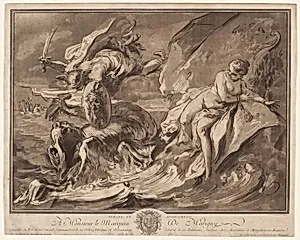
Persée et Andromede (Perseus and Andromeda)
Medium
etching and aquatint with roulette and burnishing printed in brown-black on laid paper
Dimensions
image: 34.5 × 47.8 cm (13 9/16 × 18 13/16 in.) sheet (trimmed within platemark): 40.6 × 50.7 cm (16 × 19 15/16 in.)
Classification
Department
CG-E
Museum
National Gallery of Art, Washington, D.C.
Credit
Pepita Milmore Memorial Fund
Accession Number
2018.91.8
Rights
Public Domain
Art Historical Context
This striking print captures the dramatic rescue of Andromeda by the hero Perseus, a beloved episode from classical mythology. Created in 1762 by printmaker François-Philippe Charpentier after an original composition by Carle Van Loo, the image reflects the elegance and theatricality of mid-eighteenth-century French art. Van Loo, a leading court painter during the reign of Louis XV, specialized in grand mythological and historical subjects that blended Rococo grace with emotional intensity. Charpentier’s masterful use of etching combined with aquatint, roulette, and burnishing allowed him to translate the luminous tones and dynamic movement of Van Loo’s painting into a rich, velvety brown-black print. These innovative techniques, still relatively new in 1762, enabled subtle gradations of light and shadow that evoke the churning sea and the gleaming figure of Perseus descending from above. The result is both a faithful reproduction and a work of art in its own right. Housed in the National Gallery of Art, this impression on laid paper exemplifies the period’s growing appreciation for reproductive prints as vehicles for sharing celebrated paintings with wider audiences. Its refined execution highlights the technical sophistication of French printmaking on the eve of the Neoclassical turn.