
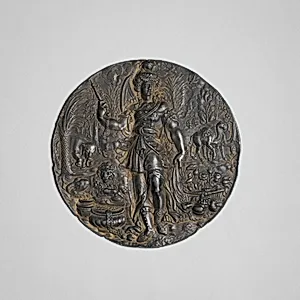
Personification of Asia
Unknown Artist
1580–90
Medium
Lead and gilding.
Dimensions
Diameter: 6 7/8 in. (17.5 cm)
Classification
Medals and Plaquettes
Culture
German
Department
European Sculpture and Decorative Arts
Museum
Metropolitan Museum of Art, New York, NY
Credit
Rogers Fund, 1960
Accession Number
60.70.2
Rights
Public Domain
Tags
Art Historical Context
This exquisite *Personification of Asia*, crafted by an unknown German artist between 1580 and 1590, is a finely detailed plaquette—a small, collectible relief popular during the Renaissance for its portability and sculptural appeal. Measuring just 6 7/8 inches in diameter, it belongs to the tradition of medals and plaquettes housed in the Metropolitan Museum of Art's European Sculpture and Decorative collection, acquired through the Rogers Fund in 0. Fashioned from lead and enhanced with gilding, medium lends a subtle luster that evokes luxury despite lead's relative softness, which allowed for intricate casting of motifs like lions, animals, men, and trees. These elements likely symbolize Asia's exotic landscapes and fauna, common in allegorical art of the era, when European artists personified continents amid growing global explorations and mapmaking. As a cultural artifact from late 16th-century Germany, it reflects the Renaissance fascination with the wider world, blending humanism with symbolic representation. Visitors will appreciate its intimate scale, perfect for contemplation, and the gilded glow that brings this distant continent vividly to life.