
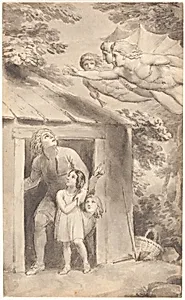
Peter and His Children Visited by Three Flying Figures
c. 1783
Medium
pen and gray ink with gray wash over graphite on wove paper
Dimensions
overall: 11.3 x 6.9 cm (4 7/16 x 2 11/16 in.)
Classification
Drawing
Department
CG-E
Museum
National Gallery of Art, Washington, D.C.
Credit
Gift of William B. O'Neal
Accession Number
1995.52.171
Rights
Public Domain
Art Historical Context
In the late 18th century, artist Thomas Stothard (1755–1834) captured whimsical narratives in delicate drawings like *Peter and His Children Visited by Three Flying Figures* (c. 1783). A prominent illustrator and Royal Academy member, Stoth drew inspiration from literature, mythology, and everyday fantasy, blending neoclassical elegance with emerging Romantic sensibilities. This intimate scene likely evokes a fairy-tale moment, with ethereal flying figures descending upon Peter and his children, highlighting Stothard's skill in storytelling through subtle expression and movement. Executed on wove paper—a smooth, durable support favored for detailed work—the drawing employs graphite underdrawing for precise outlines, layered with pen and gray ink for crisp lines, and gray wash for soft tonal modeling. At just 11.3 x 6.9 cm, its miniature scale suggests it was a preparatory sketch, perhaps for a book illustration or larger painting, showcasing Stothard's mastery of mixed media to evoke depth and atmosphere in limited space. Now housed in the National Gallery of Art as a gift from William B. O'Neal (Department CG-E), this work exemplifies the era's fascination with the supernatural visiting the domestic sphere, offering visitors a glimpse into Stothard's imaginative world and the artistry of British draftsmanship.
About the Artist
Thomas Stothard · 1755–1834
Thomas Stothard RA (1755–1834) was born on 17 August 1755 at the Black Horse Inn in London's Long Acre, the son of a prosperous publican originally from Stutton near Tadcaster. A delicate child, he was sent at age five to relatives in Yorkshire, attending schools in Acomb, Tadcaster, and later Ilford, Essex, where he honed his drawing skills by copying prints. Following his father's death in 1770,...