
Petroglyph
1935/1942
Medium
lithograph on paper
Dimensions
Overall: 28.3 x 37.3 cm (11 1/8 x 14 11/16 in.) overall: 36.5 x 46 cm (14 3/8 x 18 1/8 in.)
Classification
Index of American Design
Department
CG-W
Museum
National Gallery of Art, Washington, D.C.
Credit
Index of American Design
Accession Number
1943.8.7627
Rights
Public Domain
Art Historical Context
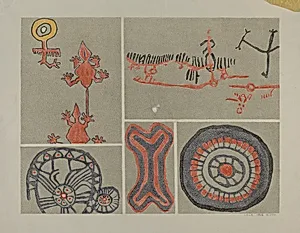
**Petroglyph** by Lala Eve Rivol a captivating lithograph on paper from the Index of American Design, between 1935 and1942. Measuring 28.3 x 37.3 cm (with a mat of 36.5 x 46 cm), this captures the ancient artistry of rock carvings—petroglyphs—integral to America's indigenous heritage. Rivol, one of many talented artists employed in this ambitious project, rendered these timeless symbols with precision, preserving their form for future generations. The Index of Design was a Federal Art Project under the Works Progress Administration (WPA) during the Great Depression, aimed at documenting the nation's folk art, crafts, and design traditions. Spanning 1935 to 1942, it produced thousands of watercolor and graphic renderings, including this lithograph, which highlights Native American petroglyphs as foundational elements of American cultural identity. By translating enduring stone incisions into a reproducible print medium, the work made these prehistoric motifs accessible and celebrated their artistic significance. Lithography, with its fine detail and tonal range, was ideal for faithfully reproducing the weathered textures and symbolic power of petroglyphs. Housed in the National Gallery of Art's CG-W Department, **Petroglyph** invites visitors to reflect on how early American design echoes through time, bridging ancient Native traditions with modern preservation efforts.
About the Artist
Lala Eve Rivol · 1913–1996
Lala Eve Rivol is an artist about whom very little has been documented in readily accessible art historical sources. Her nationality, dates, training, and the full scope of her artistic output remain unclear, placing her among the many artists — often women — whose careers were not systematically recorded or preserved in the mainstream institutional record. Where her work has been catalogued, it ...